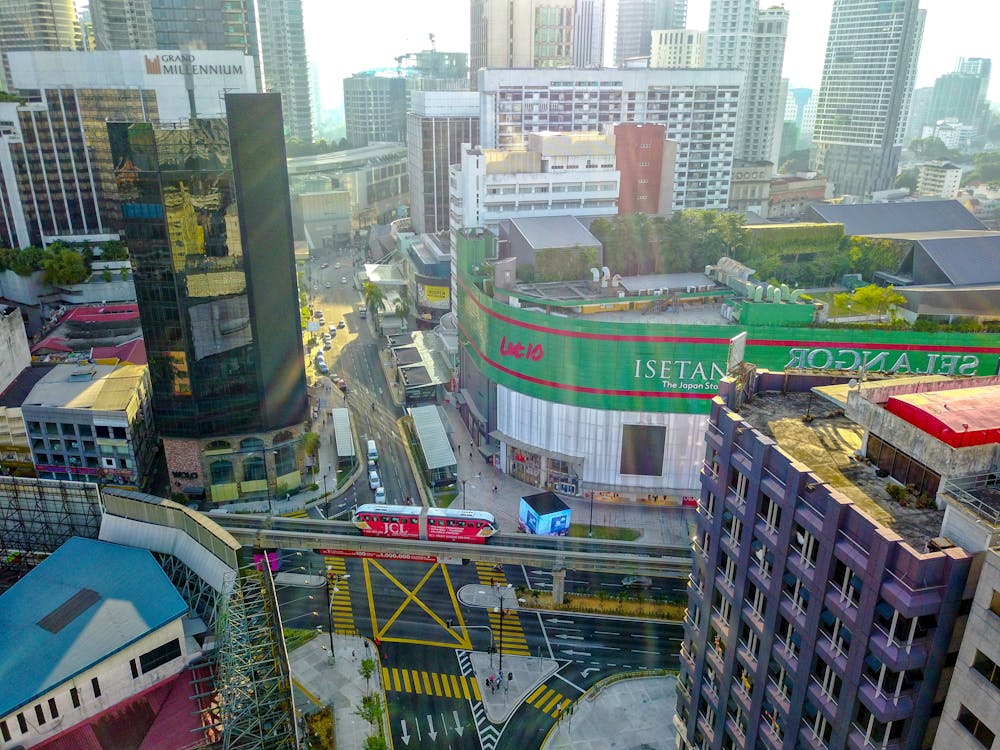
The cheapest grocery stores in Bukit Bintang: KL’s most curious grocery district, where Mydin and Isetan compete on the same kilo of tomato
We pulled every grocery price recorded by KPDN across 17 stores in Bukit Bintang since 2022. The data tells a story you won’t find in any other Klang Valley district: this single 5km square contains LuLu Hypermarket, four Japanese department-store grocers, three premium specialty chains, and Mydin Sinar Kota — all selling the same brand of Maggi Mi Kari, at wildly different prices, sometimes within the same shopping mall.
The 15-minute drive that costs you 28%
Most KL residents who live or work in Bukit Bintang have never noticed something the data makes obvious: Mydin Sinar Kota and Cold Storage KLCC are 2500 meters apart. The two stores serve almost the same geographic area. They stock many of the same SKUs. They open during overlapping hours. But they serve very different crowds indeed. The people who do their shopping in KLCC have most probably never stepped foot in Mydin Sinar Kota ever.
And on any given day, Cold Storage KLCC charges meaningfully more for the identical product. So the truth is, if you’re wiling to deviate from the norm, and take a bit of a drive and get to Jalan Tun Perak, you will be able to save a lot more on your groceries. Over a sustained period of time, the savings built over time compound and become significant. That’s our main goal – to introduce a new concept (actually not really a new concept, but we just want people to know you have more options than you think).
Most KLCC office workers and condo residents who do their weekly shop at Cold Storage have probably never compared. The premium is roughly 15-25% on identical packaged SKUs — meaningful when accumulated over a year of weekly grocery runs. For a typical RM 600/month KLCC-resident grocery basket, defaulting to Mydin Sinar Kota over Cold Storage saves approximately RM 90-120/month, or RM 1,200-1,500/year.
The unique BB shopping ecosystem
What makes Bukit Bintang’s grocery landscape unlike any other Klang Valley district isn’t just price diversity — it’s concept diversity. In our analysis covering five Klang Valley districts so far, no other district contains:
- Four Japanese department-store grocers within 3km of each other (Isetan KLCC, Isetan Lot 10, SOGO KL, SEIBU TRX)
- Two Italian-themed premium chain locations (Mercato Pavilion + Mercato TRX)
- LuLu Hypermarket, the only Middle Eastern-owned hypermarket in Malaysia and the only LuLu in our entire dataset
- Three NSK Grocer locations within 2km (NSK Times Square, NSK Quill City, plus the related Bhuiyen K Petaling Street)
- An ambient luxury chain (Selections Groceries) in Wisma Lim Foo Yong that exists nowhere else in our data
- ST Rosyam Mart Jakel Square, sitting opposite all this premium retail and quietly winning on price almost everywhere
This creates a grocery landscape with extremely sharp segmentation — different customer bases use different stores almost without overlap. The KLCC-condo expat shops at Cold Storage; the Pavilion mall worker grabs 99 Speedmart on the way home; the Petaling Street resident shops at Bhuiyen K or Pasar Mini Hoo Hing; the Jalan Pudu working family goes to Mydin Sinar Kota. They live in the same square kilometre. They almost never encounter each other’s price reality.
Bukit Bintang’s retail diversity is downstream of one specific structural fact: the district’s population is heterogeneous to an extent unmatched anywhere else in KL. Within walking distance of Pavilion you have luxury condo expats (Mont Kiara-tier incomes), white-collar mall workers (mid-income), Petaling Street merchants and their families (mixed-income, Chinese-majority), Jalan Pudu and Bukit Bintang back-lane residents (lower-income, multi-ethnic), tourists from China and Singapore, and a substantial Bangladeshi/Burmese migrant worker population.
Each of these populations has different price sensitivity, different familiar brands, and different convenient locations. That heterogeneity sustains a retail diversity you won’t find in PJ (uniformly affluent), Cheras (uniformly working-class), or Mid Valley (uniformly mall-tier middle-class). Bukit Bintang is, in a real sense, KL’s most ungentrified district — and the grocery data is one of the cleanest places to see it.
The Japanese department store premium
A persistent KL myth says Japanese supermarkets are expensive because they’re “premium.” The data quantifies the actual gap.
The narrative that “Japanese department stores in KL are premium-priced” is correct in the aggregate but misleading in the specific. ISETAN KLCC and SEIBU TRX sit at 76% and 74% percentile — genuinely the most expensive stores in our entire BB analysis. But SOGO KL sits at 59% — barely worse than Cold Storage KLCC, and meaningfully cheaper than Village Grocer Avenue K (71%). Two stores from the same broad category occupy completely different price tiers.
The pattern within ISETAN itself is also worth knowing. We didn’t have enough overlapping items to rank Isetan Lot 10 against other stores at the 30+ item threshold, but on the items we could compare, Lot 10 was meaningfully cheaper than KLCC. The KLCC location appears to charge a “tourist tax” reflecting its mall positioning, not a “Japanese chain tax” inherent to the brand.
The takeaway: don’t write off all Japanese department-store groceries as expensive. Check the actual store. SOGO KL competes credibly with mid-tier supermarkets despite the prestige branding. Isetan KLCC really is more expensive than 80% of other stores in BB district. Both facts are true.
The 10 cheapest grocery stores in Bukit Bintang
Ranked by average price percentile across items stocked. Lower percentile = consistently cheaper.
The most expensive stores
By store type: where 99 Speedmart breaks the rules
Average price percentile by store format. Bukit Bintang has only one hypermarket (LuLu), so the comparison structure differs from other districts.
In our analysis of five Klang Valley districts, 99 Speedmart has consistently appeared in the cheapest store rankings, despite being a convenience-format chain that most people associate with paying convenience-tier prices for top-up purchases. In Bukit Bintang specifically, the Tiong Nam branch ranks #1 — at 17.9% percentile, it’s cheaper than every named hypermarket, supermarket, and premium chain in the district.
The mechanism appears to be: 99 Speedmart only stocks ~60-70 fast-moving SKUs per store, but it prices those SKUs aggressively to compete with hypermarkets on convenience occasions. The combination of small basket + sharp pricing means that for the limited grocery items it actually carries, 99 Speedmart in BB is genuinely the cheapest option.
The caveat: you cannot do a complete weekly grocery shop at 99 Speedmart. With only ~60 SKUs stocked, you’ll need a primary store (ST Rosyam Mart Jakel Square, Mydin Sinar Kota, or NSK Grocer Times Square) for most of your trolley. But for top-up runs or specific items 99 Speedmart carries, it’s strictly better than the typical alternative.
Cheapest store for each common item
Where to buy each staple at the lowest price in Bukit Bintang district, April 2026
The pattern is striking. ST Rosyam Mart Jakel Square wins on 6 items, NSK Grocer Times Square on 5, Mydin Sinar Kota on 4. Together those three stores cover 15 of the 18 hero items at the lowest price. For BB shoppers, the optimal route depends on which mall side you live on: Jalan Pudu/Petaling Street → Mydin + ST Rosyam; KLCC/Bukit Bintang → NSK Quill City + 99 Speedmart Tiong Nam.
How Bukit Bintang compares to its KL/PJ neighbours
Same items, five Klang Valley districts, April 2026 median prices. Cheapest in row highlighted green.
Bukit Bintang’s median grocery prices are middle-of-the-pack across the Klang Valley — neither the cheapest district (PJ wins that crown) nor the most expensive (Lembah Pantai). What makes BB different isn’t its average; it’s its variance. The same 17 stores that produce a middling district median include the cheapest store we’ve measured anywhere (99 Speedmart Tiong Nam at 17.9% percentile) and the most expensive (Isetan KLCC at 76.1%). The intra-district spread of 58 percentile points is the widest we’ve measured.
This makes BB the highest-leverage district for shopping discipline. A BB shopper who switches from Isetan KLCC to ST Rosyam Mart Jakel Square is making a bigger improvement than any cross-district move available in the Klang Valley. Conversely, a BB shopper who defaults to nearby Cold Storage KLCC simply because of proximity is overpaying by more than they would in any other district. Knowledge of the local geography is worth more in BB than anywhere else in KL.
Bukit Bintang grocery inflation since 2022
How BB has tracked alongside other Klang Valley districts since June 2022 (June 2022 = 100)
Bukit Bintang’s inflation trajectory contains the single most volatile reading in our entire Klang Valley analysis. Prices peaked at +19.5% above June 2022 levels in December 2025 — the highest single-month reading we’ve recorded in any KV district. They retreated sharply in early 2026, falling to +11.2% by April. This pattern is consistent with the structural fact that BB has only one hypermarket (LuLu), limited mid-tier supermarket competition, and a high concentration of premium retail — the district lacks the price-anchoring force that hypermarket-dense districts like PJ have.
Bukit Bintang’s December 2025 spike particularly affected packaged goods and imported items, suggesting it traces partly to ringgit weakness and partly to year-end inventory rebuild pricing in mall-based stores. The retreat into Q1 2026 brought BB back roughly in line with Lembah Pantai and Cheras, but BB is structurally vulnerable to similar shocks recurring whenever input costs rise. Without significant new mid-tier retail entering the district, the volatility is unlikely to subside.
Calculate your Bukit Bintang grocery savings
Estimate how much switching from a typical mall-tier store to a value option could save you
The default 13% savings rate reflects BB’s unusually wide cheapest-vs-typical gap. A KLCC condo resident switching from Cold Storage to Mydin Sinar Kota or a Pavilion-area office worker switching from Mercato to ST Rosyam Mart captures more savings than in any other Klang Valley district. Only Lembah Pantai approaches BB on this dimension.
The practical guide for Bukit Bintang shoppers, by area
The Bukit Bintang shopping principle
The single most useful BB-specific insight from this analysis is that convenient-mall-store ≠ best-value-store. In every other Klang Valley district, the cheapest stores are usually the obvious large-format hypermarket choices. In BB, the cheapest stores are tucked-away supermarkets in tourist-adjacent commercial complexes (ST Rosyam Mart in Jakel Square), 7-minute walks from mall entrances (99 Speedmart Tiong Nam), or in old-format properties locals overlook (Mydin Sinar Kota on Jalan Pudu). The mental rule “I’ll just shop at the supermarket in the mall I’m at” costs BB residents and workers more here than anywhere else.
What’s the savings really worth in Bukit Bintang?
BB demographics span an unusually wide range — KLCC condo residents (RM 12,000+ household income), Pavilion-area office workers (RM 6,000-9,000), Petaling Street shop-owner families (RM 4,000-6,000), Bukit Bintang back-lane residents (RM 3,000-4,500). Different income tiers face different shopping defaults and therefore different savings opportunities.
The single most consequential financial decision a BB resident can make at the grocery counter is choosing not to default to whichever supermarket is most convenient. For a typical RM 500/month grocery spend, switching from a mall-tier default (Cold Storage KLCC, Mercato TRX, Village Grocer Avenue K) to ST Rosyam Mart Jakel Square or Mydin Sinar Kota captures roughly 13% — about RM 65/month, or RM 780/year.
Compounded over a 30-year working life at a conservative 6% real return, that RM 65/month invested in Amanah Saham, EPF i-Saraan, or a low-cost equity index fund grows to roughly RM 61,000. At 8% nominal returns it’s closer to RM 92,000. The most expensive parts of BB’s residential geography (KLCC, TRX, Bukit Bintang back-lane condos) all fall within walking or short-driving distance of the cheapest stores in the district. The geographic friction is among the lowest in KL. The behavioural friction — defaulting to whatever’s most convenient — is what costs people the money.
Sikit-sikit, lama-lama jadi bukit applies in BB with unusual force precisely because the convenient choice is so often expensive, and the cheap alternative is so often a five-minute walk further.